
March 29, 2026
By : Sophia Patel
Trending Topics Analyst at Godam.click
As the United Kingdom and most of Europe prepare to advance clocks by one hour on Sunday, 29 March 2026, millions will participate in the familiar biannual ritual of daylight saving time (DST). Known in the UK as British Summer Time (BST), this practice shifts the nation from Greenwich Mean Time (GMT) to BST (UTC+1), delivering longer evenings at the cost of darker mornings. For many, the change is a welcome herald of spring; for others, it disrupts sleep patterns, daily routines, and even national infrastructure. Yet behind the simple mnemonic “spring forward, fall back” lies a complex tapestry of wartime necessity, scientific debate, economic interests, cultural folklore, and ongoing public contention.
This article explores the full history of daylight saving time with a particular focus on the UK’s experience — from its earliest proposals to the precise mechanics of clock changes, the health and economic impacts backed by recent studies, and the persistent calls to abolish the twice-yearly adjustment. Whether you are researching daylight saving time UK 2026, British Summer Time rules, or the broader global context, this comprehensive guide provides the facts, folklore, and fuss surrounding one of modernity’s most debated timekeeping traditions.
Origins of Daylight Saving Time: From Insect Collecting to Wartime Strategy
The concept of adjusting clocks to make better use of daylight is far older than most realise, yet the modern formulation of DST emerged in the late 19th century. Contrary to popular myth, Benjamin Franklin did not invent it; his 1784 satirical essay merely urged Parisians to rise earlier to save candle wax. The first practical proposal came in 1895 from George Vernon Hudson, a New Zealand postal worker and amateur entomologist. Hudson presented a paper to the Wellington Philosophical Society advocating a two-hour clock shift forward in summer. His motivation was pragmatic: more evening daylight for collecting insects after his day job. Although the idea gained local interest, it was not adopted at the time.
A decade later, British builder William Willett independently developed a similar concept during an early-morning horseback ride in Petts Wood, Kent. Disturbed by the sight of drawn curtains despite bright summer mornings, Willett published his influential 1907 pamphlet The Waste of Daylight. He proposed advancing clocks by 20 minutes each Sunday in April (total 80 minutes) and reversing the process in September. Willett argued this would boost health, reduce coal consumption for lighting, and provide extra leisure for outdoor pursuits such as cricket, gardening, and cycling. His campaign attracted high-profile supporters, including future Prime Minister Winston Churchill and Arthur Conan Doyle, creator of Sherlock Holmes. Parliament debated the idea repeatedly between 1908 and 1915, yet it was repeatedly rejected.
Willett died of influenza in March 1915, never seeing his vision realised. Just over a year later, however, the pressures of the First World War transformed theory into practice. Germany became the first nation to implement DST on 30 April 1916, advancing clocks by one hour to conserve coal and extend productive daylight for the war effort. Britain followed swiftly with the Summer Time Act 1916, introducing British Summer Time from 21 May to 1 October. France and the United States soon joined. The UK’s adoption was explicitly framed as a wartime measure, yet public consultation after the first year revealed widespread popularity. The practice endured beyond the armistice, enshrined permanently by the Summer Time Act 1925.
Willett’s legacy endures in unexpected ways. His great-great-grandson, Coldplay frontman Chris Martin, coincidentally released the hit single “Clocks” in 2002 — a curious cultural footnote to the time-shifting idea that began in a Kent riding stable.
For a deeper dive into the evolution of UK timekeeping standards, see our related article Greenwich Mean Time and the History of Standard Time in Britain.
British Summer Time in the UK: A Century of Clock Changes and Adaptations
In the United Kingdom, daylight saving time has been known as British Summer Time since its formal introduction. The core rule remains straightforward: clocks advance one hour at 01:00 GMT on the last Sunday in March and revert at 02:00 BST on the last Sunday in October. For 2026, this means clocks will spring forward on 29 March and fall back on 25 October. These dates are now harmonised across the UK and much of the European Union, a alignment formalised in 1995 and retained post-Brexit.
The UK’s relationship with DST has not always been uniform. During the Second World War, Britain introduced British Double Summer Time (BDST) in 1941–1945, advancing clocks two hours ahead of GMT during summer and one hour in winter to maximise wartime productivity and conserve fuel. A brief return to BDST occurred in 1947. Post-war, the nation reverted to standard BST, but the 1960s saw a bold experiment: between 1968 and 1971, Britain trialled permanent BST year-round. The goal was to align more closely with European trading partners and enjoy lighter evenings. Public backlash was fierce, however — particularly in Scotland and northern England, where winter mornings remained dark until nearly 10am. The trial ended, and the Summer Time Act 1972 restored the familiar biannual pattern still observed today.
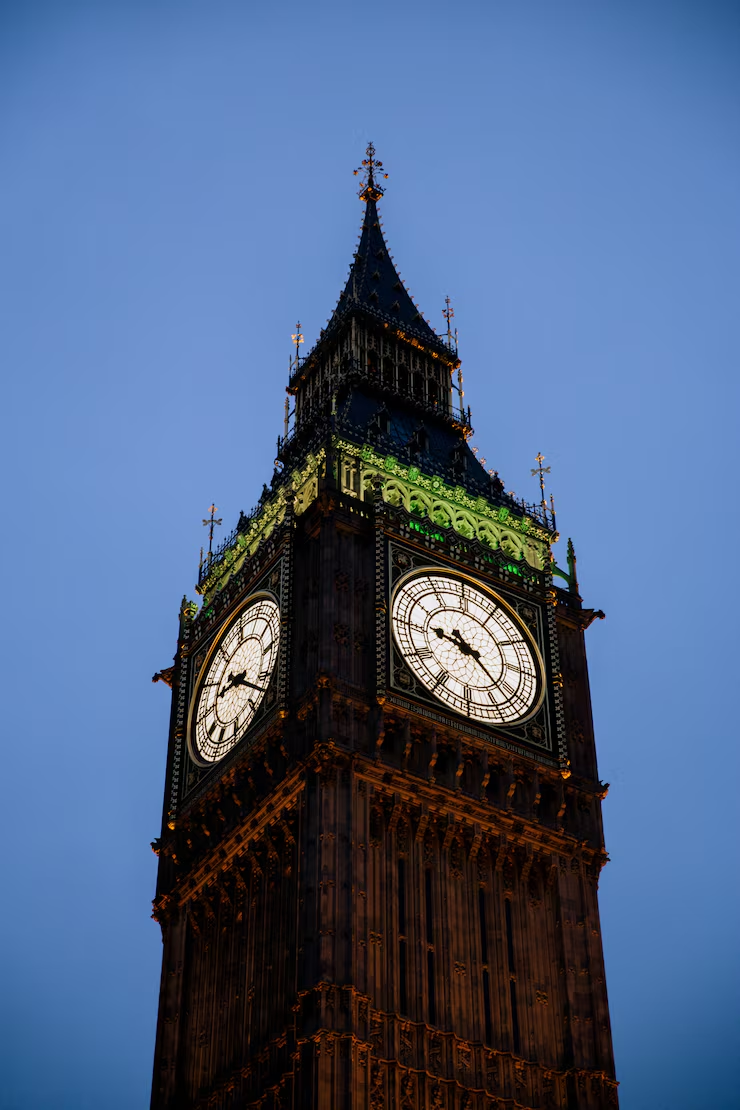
The UK’s time base is anchored in Greenwich Mean Time, historically derived from solar observations at the Royal Observatory in Greenwich. GMT (UTC+0) serves as the global standard for much of the year, while BST shifts civil time to UTC+1. This system affects everything from railway timetables and financial markets to medical appointments and air-traffic control. Modern digital systems largely adjust automatically via Network Time Protocol (NTP), yet analogue clocks, ovens, and older heating systems still require manual intervention.
Official UK government guidance on exact dates and rules is available at GOV.UK – When do the clocks change?.
How Clock Changes Actually Work in the UK: Mechanics, Technology and Everyday Impact
At precisely 01:00 GMT on 29 March 2026, the UK’s civil time will jump forward to 02:00 BST. The reverse occurs in October. This is not merely a household inconvenience; it requires coordination across broadcasting, telecommunications, energy grids, and transport networks. The BBC and other broadcasters issue public reminders, while airlines and rail operators adjust schedules weeks in advance to avoid disruptions.
Health professionals note that the spring transition compresses the night, resulting in an average loss of 40–65 minutes of sleep on the affected Sunday and Monday. Studies cited by the London School of Economics and others link this to short-term spikes in heart attacks, workplace accidents, and road collisions — effects that largely dissipate within days but highlight the circadian misalignment caused by abrupt social-clock shifts. The autumn change, by contrast, grants an extra hour, often associated with modest improvements in reported wellbeing.
“Explore the economic ripple effects in our companion piece The Real Cost of DST on UK Businesses and Households.”:”
“The Royal Museums Greenwich offers an excellent illustrated history at UK Time: British Summer Time (BST) Explained.”
Global Context and UK Comparisons: Who Observes DST and Why It Matters
Globally, only about one-third of countries observe daylight saving time, primarily in temperate zones of the Northern and Southern Hemispheres. Most of Africa, Asia, and tropical regions forgo it entirely, citing minimal seasonal daylight variation. In the United States, Hawaii and most of Arizona opt out, creating the curious “Arizona Daylight Saving Donut” where the Navajo Nation observes DST while the surrounded Hopi Reservation does not. Australia’s participation is state-dependent, while New Zealand observes it nationwide.The UK’s alignment with European neighbours has practical benefits for cross-Channel trade, aviation, and broadcasting, yet post-Brexit independence allows future divergence if Parliament chooses. Southern Hemisphere nations such as Australia and Chile reverse the cycle — advancing clocks in September/October and retreating in March/April — to match their seasonal rhythms.
Benefits, Drawbacks and the Evidence Base: Why the Debate Persists
Proponents highlight measurable gains. Longer summer evenings encourage outdoor activity, boost retail and hospitality spending, and reduce evening road accidents and crime. Historical wartime data showed genuine energy savings; modern analyses are more nuanced, with some studies suggesting modest electricity reductions offset by increased heating or air-conditioning use in mornings.
Critics, however, point to robust evidence of costs. A 2024 LSE study estimated that the biannual clock changes impose an economic burden exceeding €750 per capita annually when factoring in health, productivity, and wellbeing losses. The British Sleep Society officially recommends abolishing DST and adopting permanent Standard Time (GMT) to better align social and biological clocks. Chronic misalignment is linked to higher rates of obesity, depression, cardiovascular events, and reduced life expectancy in western time zones. Livestock farmers have long complained that animals do not adjust to human clocks, disrupting milking and feeding schedules.
Public opinion in the UK remains divided. Recent YouGov polls indicate that if the twice-yearly change were scrapped, a majority would prefer permanent BST for lighter evenings, yet sleep researchers strongly favour permanent GMT for morning light exposure and circadian health.
Folklore, Myths and Cultural Fuss: From Candy Lobbying to Modern Memes
DST has spawned its share of colourful folklore. In the United States, the confectionery industry reportedly lobbied Congress in the 1980s and 2000s to extend DST past Halloween, placing candy pumpkins on senators’ desks to secure longer trick-or-treating hours and increased sales. The 2005 Energy Policy Act duly pushed the end date into November. While UK folklore is less commercial, the ritual itself has entered popular culture — from radio DJ countdowns to viral social-media memes about lost sleep and confused pets.Myths persist: many still credit Franklin or claim DST was invented purely for farmers (in reality, agricultural lobbies have often opposed it). The “fuss” today centres on health data, economic modelling, and the growing chronobiology field that studies how artificial time shifts affect human physiology.
The Future of Daylight Saving Time in the UK: Abolition or Permanence?
The European Parliament voted in 2019 to end seasonal clock changes, yet implementation stalled over disagreement on whether to adopt permanent summer or winter time. The UK government has shown no immediate plans to deviate from current practice, but the British Sleep Society’s 2024 position statement urging permanent GMT has reignited debate. Scotland and Northern Ireland, with their higher latitudes, would experience more pronounced winter darkness under permanent BST, adding political complexity.
Any decision would require parliamentary legislation and careful coordination with trading partners. Until then, the UK will continue its rhythmic dance with the sun twice each year.
Conclusion: Time for Reflection on Our Clocks
Daylight saving time began as a pragmatic response to war and a desire to reclaim “wasted” daylight. Over a century later, it embodies deeper questions about how humans organise time in an increasingly 24/7 world. The UK’s experience — from Willett’s pamphlet to the precise 01:00 GMT shift on 29 March 2026 — illustrates both the ingenuity and the unintended consequences of tampering with the clock.
Whether the practice endures, evolves into permanent BST, or returns to unadjusted GMT will depend on balancing economic convenience, public preference, and emerging scientific evidence on sleep and health. Until that decision, the advice remains simple: remember to check your clocks, adjust your routines gently, and perhaps enjoy the extra evening light while reflecting on the long, tangled history behind it.